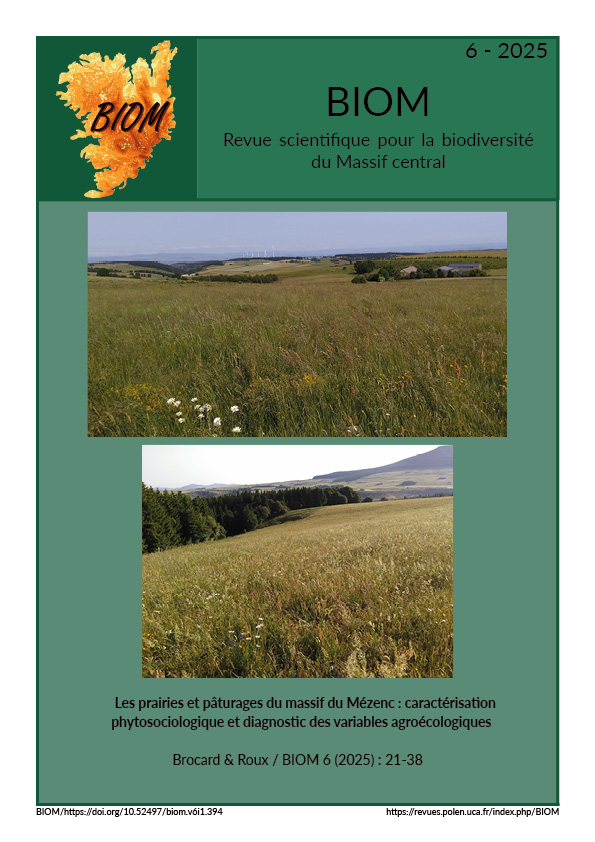
Meadows and pastures of the Mézenc massif: phytosociological characterization and diagnosis of agroecological variables
DOI:
https://doi.org/10.52497/biom.v6i1.394Keywords:
Nardetea strictae, Arrhenatheretea, habitat 6520* et 6230*Abstract
The Mézenc massif, located in the Massif central, is known for its production of «Fin gras» meat, which is promoted by a Protected Designation of Origin (PDO). The permanent mown and grazed meadows of the PDO, habitats of European interest (6520 and 6230*), are still little known because little prospected in this territory. As part of this study, these vegetations were characterized by classification analyses (MTC) in two reference systems of 376 and 225 surveys of the Massif central. The 79 surveys of Mézenc were also analyzed by classification then by ordination (DCA and CCA) to determine the variations present. In addition, the groups highlighted were compared by ANOVA based on the ecological indices of Ellenberg et al., pastoral values, diversity and specific richness. The pastures have shown that they are floristically richer, with a diversity and pastoral values similar to the hay meadows; they therefore contribute to the quality of the meat produced on the AOP air. These pastures correspond to the association of Diantho pseudocollini-Meetum athamantici (Luquet 1926) B.Foucault 1986 mut. Le Hénaff et al. 2021 but higher in altitude than in the monts Dore. They lead us to differentiate a new sub-association specific to Mézenc named bellardiochloetosum variegatae, reflecting its more mountainous character. Four variants have been highlighted: one on granite, one more thermoxerophilic and two others showing a difference in the more or less extensive livestock loading. As for the Mézenc mowings, their floristic and biogeographical originality is highlighted by naming a new plant association of Triseto flavescentis-Polygonion bistortae Braun-Blanq. & Tüxen ex Marschall 1947: Campanulo scheuchzeri-Trisetetum flavescentis. The latter is located on basaltic summit plateaus, higher in altitude and more eastern of the volcanic mountains of Auvergne.
References
Baize D., Girard M.-C., Jabiol B., Rossignol J.-P., Eimberck M. & Beaudou A., 2008. Référentiel pédologique. Association française pour l’étude des sols (AFES). Éditions Quae, 435p.
Bambier A., Berger E.-T., Mergoil J., Valadas B., Veyret Y. & Weisbrod A., 1985. Notice explicative, Carte géologique de France (1/50 000), feuille Burzet (840). BRGM, Orléans, 47p.
Bensettiti F., Gaudillat V. & Haury J., 2005. Cahiers d’habitats Natura 2000. Connaissance et gestion des habitats et des espèces d’intérêt communautaire. Tome 4 : Habitats agropastoraux. MATE/MAP/MNHN. Édition La Documentation française, Paris, 487 p.
Billy F., 2000. Prairies et pâturages en Basse-Auvergne. Bulletin de la Société Botanique du Centre-Ouest, N.S., 20, 259 p.
Bouxin G., 2016. Analyse statistique des tableaux de relevés de végétation. Recherche d’adéquation entre les données de végétation et les techniques statistiques, au moyen d’exemples. Éditions Universitaires Européennes, 440 p.
Braun-Blanquet J., 1932. Plant sociology, the study of plant communities. McGraw-Hill, New York, 476 p.
Braun-Blanquet J., 1964. Pflanzensoziologie Gründzuge der Vegetationskunde. Springer 3rd Edition Vienna, 865p.
Cahier des charges (CDC) de l’appellation d’origine « Fin gras » ou « Fin gras du Mézenc », 2012. Bulletin officiel du Ministère de l’agriculture, de l’alimentation, de la pêche, de la ruralité et de l’aménagement du territoire, 24 p.
Chytrý M., Tichý L., Holt J. & Botta-Dukat Z., 2002. Determination of diagnostic species with statistical fidelity measures. Journal of Vegetation Science, 13 : 79-90. https://doi.org/10.1111/j.1654-1103.2002.tb02025.x
Daget P. & Poissonet J., 1972. Un procédé d’estimation de la valeur pastorale des pâturages. Fourrage, 49 : 31-39.
Daget P. & Poissonet J., 2010. Prairies et pâturages, méthodes d’étude de terrain et interprétations. CNRS/Cirad, 955 p.
Defive E., Meinard Y., Courrioux G., Ledru P., Poiraud A., Prognon C. & Bertin C., 2011. Notice explicative, Carte géologique de France (1/50 000), feuille Le Monastier-sur-Gazeille (816). BRGM, Orléans, 196 p.
Ellenberg H., Dull R., Wirth V., Werner W. & Paulissen D., 1992. Zeigerwerte von Pflanzen in Mitteleuropa. Scripta Geobotanica, 18 : 1-248.
Feybesse J.-L., Turland M., Nehlig P., Alsac C., Mercier-Batard F., Périchaud J.-J., Vialaron C. & De Bayle des Hermens R., 1998. Notice explicative, Carte géologique de France (1/50 000), feuille Yssingeaux (792). BRGM, Orléans, 145 p.
Foucault B. (de), 1986. Contribution à une étude systémique des prairies de l’Aubrac (Massif Central français). Documents Phytosociologiques, 1 : 255-305.
Foucault B. (de), 2012. Contribution au prodrome des végétations de France : les Nardetea strictae Rivas Goday in Rivas Goday et Rivas-Mart. 1963. Journal de la Société Botanique de France, 59 : 241-344.
Foucault B. (de), 2016. Contribution au prodrome des végétations de France : les Arrhenatheretea elatioris Braun-Blanq. ex Braun-Blanq., Roussine & Nègre 1952. Documents Phytosociologiques, 3 : 4-217.
Géhu J.-M., 2006. Dictionnaire de phytosociologie et synécologie végétale. J.Cramer Berlin, Stuttgart, 889 p.
Gimilio R., 1972. Application des notions de continentalité au Velay-Vivarais : Étude sur la continentalité pluviale moyenne. Bulletin de la Société d’écologie, 3 : 341-353.
Glèlè Kakaï R., Salako V.-K., Padonou E.-A., Lykke A.-M., 2016. Méthodes statistiques multivariées utilisées et écologie. Annales des sciences Agronomiques, 20 : 139-157.
Guinochet M., 1973. La phytosociologie. Masson, Paris, 227 p.
Hennekens S.M. & Schaminée J.H.J., 2001. TURBOVEG, a comprehensive data base management system for vegetation data. Journal of Vegetation Science, 12 : 589-591. https://doi.org/10.2307/3237010
Hétier J.-M., 1973. Caractères et répartition des sols volcaniques du Massif central. IIème partie, Comparaison Cantal-Chaîne des Puys. Association Française pour l’Étude du Sol, 2 : 97-114.
Hill M.O. & Gauch H.G., 1980. Detrended Correspondence Analysis: An Improved Ordination Technique. Vegetation, 42 : 47-58. https://doi.org/10.1007/BF00048870
Julve P., 2022. Baseflor, http://philippe.julve.pagesperso-orange.fr/catminat.htm
Kovach, W.L., 2010. MVSP - A MultiVariate Statistical Package for Windows, version 3.2. Kovach Computing Services. Pentraeth, UK, 112 p.
Le Hénaff P.-M., Galliot J.-N., Le Gloanec V. & Ragache Q., 2021. Végétations agropastorales du Massif central, catalogue phytosociologique. Conservatoire botanique national du Massif Central, 531 p.
Leray O., Doligez P., Jost J., Pottier E. & Delaby L., 2017. Présentation des différentes techniques de pâturage selon les espèces herbivores utilisatrices. Fourrages, 229 : 11-16.
Messant A., Chafchafi A., Ducommun C., Jalabert S., Lagacherie P., Lehmann S., Lemercier B., Moulin J., Mure J.-P., Noraz A., Laroche B. & Sauter J., 2019. Les sols dominants en France métropolitaine, description des grandes familles des sols. Groupement d’intérêt scientifique sol, Sols et Territoires, 45 p.
Météociel, https://www.meteociel.fr/obs/clim/cartes_normales_records.php
Muséum National d’Histoire Naturelle - Inventaire National du Patrimoine Naturel, https://inpn.mnhn.fr/accueil/index
Mucina L., Bültmann H., Dierßen K., Theurillat J.-P., Raus T., Čarni A., Šumberová K., Willner W., Dengler J., Gavilán García R., Chytrý M., Hájek M., Di Pietro R., Iakushenko D., Pallas J., Daniëls F.J.A., Bergmeier E., Santos Guerra A., Ermakov N., Valachovič M., Schaminée J.H.J., Lysenko T., Didukh Y.P., Pignatti S., Rodwell J.S., Capelo J., Weber H.E., Solomeshch A., Dimopoulos P., Aguiar C., Hennekens S.M. & Tichý L., 2016. Vegetation of Europe: hierarchical floristic classification system of vascular plant, bryophyte, lichen, and algal communities. Applied Vegetation Science, 19(Suppl. 1) : 3-264. https://doi.org/10.1111/avsc.12257
Roleček J., Tichỳ L., Zelenỳ D. & Chytrỳ M., 2009. Modified TWINSPAN classification in which the hierarchy respects cluster heterogeneity. Journal of Vegetation Science, 120 : 596-602. https://doi.org/10.1111/j.1654-1103.2009.01062.x
Roux C. & Brocard L., 2023. Révision des pelouses xériques d’Auvergne et de la plaine du Forez. BIOM, 4 : 11-34. https://doi.org/10.52497/biom.v4i1.338
Roux C., Bioret F. & Thébaud G., 2024. Prodrome des végétations de France 2 - Tome 1 2009-2024. UniVegE et Société Française de Phytosociologie. BIOM, N.S., 5(1) : 1-324. https://doi.org/10.52497/biom.v5i1.347
Roux C. & Thébaud G., 2021. SurVegE - logiciel pour le suivi de la végétation en parcelles permanentes. BIOM, 2 : 51-61. https://doi.org/10.52497/biom.v2i1.288
Ter Braak C.J.F., 1986. Canonical correspondence analysis : a news eigenvector technique for multivariate direct gradient analysis. Ecology, 67 : 1167-1179. https://doi.org/10.2307/1938672
Tison J.M. & Foucault B. (de), 2014. Flora Gallica - Flore de France. Édition Biotope, Mèze, 1196p.
Thébaud G., Roux C., Bernard C.-E. & Delcoigne A., 2014. Guide d’identification des végétations du nord du Massif central. Presses universitaires Blaise Pascal, 274 p.
Thébaud G., Roux C., Brocard L. & Hopkins F., 2025. Les nardaies du mont Lozère (Massif central, France) Caractérisation phytosociologique et dynamique de l’habitat agropastoral d’intérêt européen prioritaire 6230*. Le Journal Botanique de la Société Botanique de France, 118 : 2-29.
Theurillat J.-P., Willner W., Fernández-González F., Bültmann H., Čarni A., Gigante D., Mucina L. & Weber H., 2020. International code of phytosociological nomenclature 4th edition. Applied Vegetation Science, 24 : 1-62. https://doi.org/10.1111/avsc.12491
Tichý L., 2002. JUICE, software for vegetation classification. Journal of Vegetation Science, 13 : 451-453. https://doi.org/10.1111/j.1654-1103.2002.tb02069.x
World Flora Online (WFO), 2025. https://www.worldfloraonline.org/