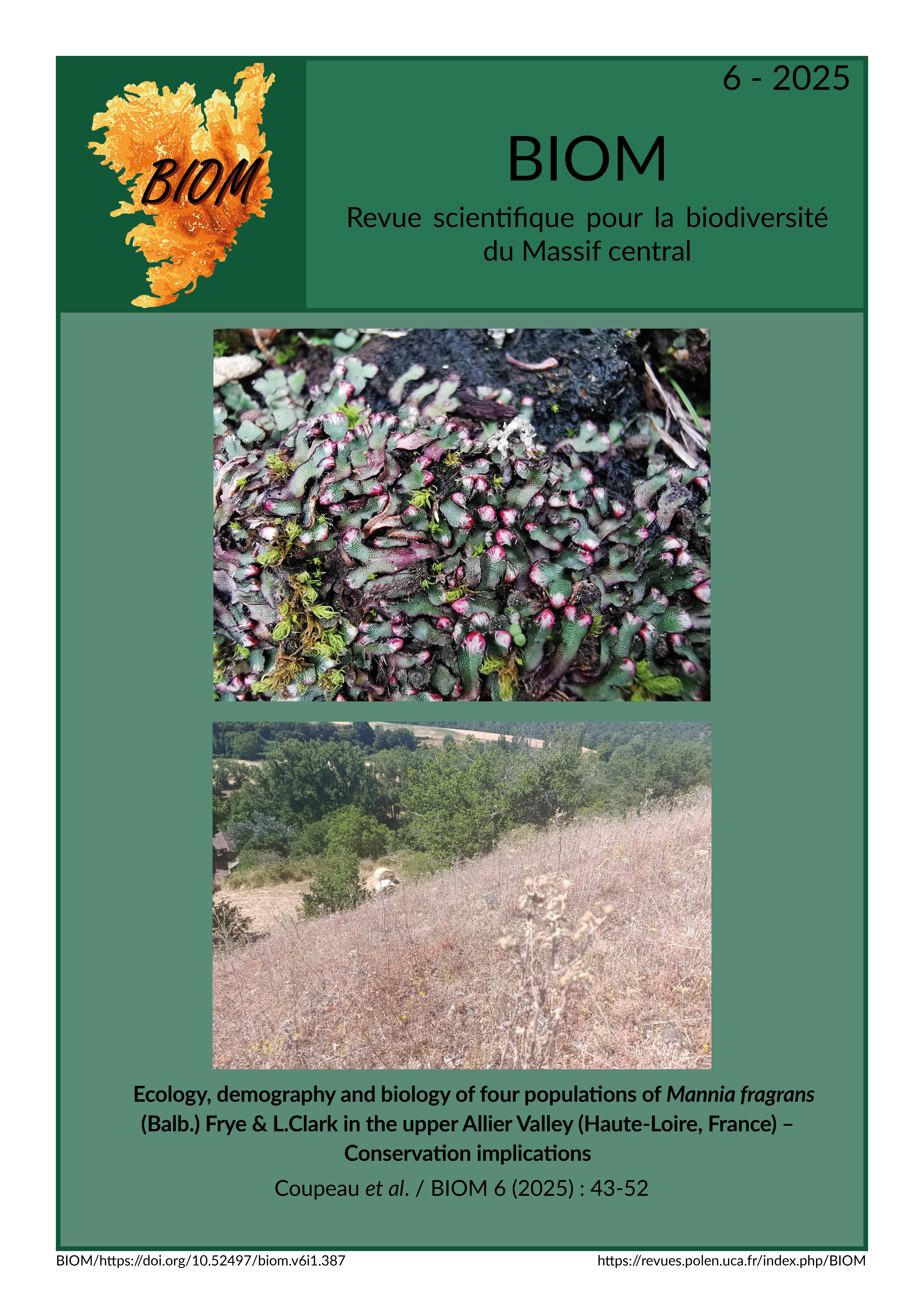
Ecology, demography and biology of four populations of Mannia fragrans (Balb.) Frye & L.Clark in the upper Allier Valley (Haute-Loire, France) – Conservation implications
DOI:
https://doi.org/10.52497/biom.v6i1.387Keywords:
Mannia fragrans, Xeric habitats, Vegetative reproduction, Bryophyte conservation, Habitat disturbanceAbstract
The populations of Mannia fragrans (Balb.) Frye & L. Clark in Haute-Loire, particularly at Blassac and Saint-Privat-d’Allier, are among the most demographically robust in Western Europe, with large population sizes and surface cover. This contrasts with marginal populations elsewhere, such as in Spain or Belgium. Unlike most European populations found on calcareous substrates, these occur on siliceous volcanic rocks. M. fragrans occupies transitional habitats between rocky outcrops and dry grasslands, where competition is limited and soil depth is sufficient. Dense bryophyte mats (e.g., Tortella squarrosa (Brid.) Limpr, Rhytidium rugosum (Hedw.) Kindb) and vascular competitors (e.g., Centaurea stoebe L.) restrict its development, particularly at Chilhac. The species thrives under harsh ecological conditions - steep slopes, shallow soils, and high rock cover - which limit plant competition. Its reproductive strategy is adapted to environmental variability, with spores released in spring and germination occurring in late summer, typically in microsites created by disturbances. Sporophyte abortion and rare germination events suggest constraints on sexual reproduction, though vegetative propagation is probably effective. Spatial distribution is patchy, conistent with by microtopographic factors and diaspores’ downslope movement via gravity and water runoff. These mechanisms promote local recolonization and delay succession. Conservation-wise, the Blassac population remains stable despite land abandonment, thanks to natural abiotic filters. Conversely, Chilhac shows signs of succession and competition, indicating a potential need for restored grazing. The spread of invasive Opuntia species, though limited for now, represents a latent threat. Continued monitoring and context-specific management may be required to preserve these rare liverwort habitats.
References
Antonetti P., Brugel E. & Kessler F., 2006. Atlas de la flore d’Auvergne. Éd. Conservatoire botanique national du Massif central, 981 p.
Bulot L.-G., 2007. Les espèces d’Opuntia (Cactaceae) naturalisées dans la haute-vallée de l’Allier (Haute-Loire). Digitalis, 6 : 50-53.
Callaway R.M., Thelen G.C., Rodriguez A. & Holben W.E., 2011. Soil biota and exotic plant invasion. Nature, 427: 731-733. https://doi.org/10.1038/nature02322
Choi S.-S., Bakalin V.A., Park S.J., Sim S.H. & Hyun C.-W., 2020. Unrecorded liverwort species from Korean flora III: New data on the distribution of Mannia fragrans (Balb.) Frye & L. Clark. Korean Journal of Plant Taxonomy, 50(2): 227-231. https://doi.org/10.11110/kjpt.2020.50.2.227
Clesse B. & Sotiaux A., 2015. Mannia fragrans (Hepaticae), espèce nouvelle pour la bryoflore belge à Viroinval (province de Namur). Une remarquable extension de son aire de répartition.Dumortiera 107 : 31-34.
Damsholt K., 2002. Illustrated Flora of Nordic Liverworts and Hornworts. Oikos Editorial Office, Lund University, Nordic Bryological Society, Lund, 837 p.
Dutoit T., 1996. Chapitre second. Mécanisme d’une succession végétale secondaire en pelouse calcicole : une approche historique. Presses universitaires de Rouen et du Havre, 91-108 p. https://doi.org/10.4000/BOOKS.PURH.8094
Frahm J.-P. & Bick F., 2013. La bryoflore des Vosges et des zones limitrophes. 3e éd. Archiv für Bryologie, 169 : 135.
French National Geographic Institute (IGN). https://geoservices.ign.fr/lidarhd
Géoportail. https://www.geoportail.gouv.fr/
Glime J.M., 2017. Bryophyte Ecology. Volume 1: Physiological Ecology. Ebook sponsored by Michigan Technological University and the International Association of Bryologists. https://digitalcommons.mtu.edu/oabooks/4
Greco R., Marino P. & Bogaard T.A., 2023. Recent advancements of landslide hydrology. WIREs Water, 10(6): e1675. https://doi.org/10.1002/wat2.1675
Hock Z., Szövényi P., Schneller J.J., Urmi E. & Toth Z., 2008. Population genetic consequences of the reproductive system in the liverwort Mannia fragrans. Plant Eology, 202: 123-134. https://doi.org/10.1007/s11258-008-9541-8
Hodgetts N.G., Söderström L., Blockeel T.L., Caspari S., Ignatov M.S., Konstantinova N.A., Lockhartg N., Papp B., Schröck C., Sim-Sim M., Bell D., Bell N.E., Blom H.H., Bruggeman-Nannenga M.A., Brugués M., Enroth J., Flatberg K.I., Garilleti R., Hedenäs L., Holyoak D.T., Hugonnot V., Kariyawasam I., Köckinger H., Kučera J., Lara F. & R. D. Porley, 2020. An annotated checklist of bryophytes of Europe, Macaronesia and Cyprus. Journal of Bryology, 42(1): 1-116. https://doi.org/10.1080/03736687.2019.1694329
Hurtado F., Estébanez B., Aragón P., Hortal J., Molina-Bustamante M. & Medina N.G., 2022. Moss establishment success is determined by the interaction between propagule size and species identity. Scientific Reports, 12: 20777. https://doi.org/10.1038/s41598-022-24354-8
Jover M., 2021. Seguiment de l’hepàtica Mannia fragrans a la Reserva Natural del Volcà de la Garrinada 2021. Generalitat de Catalunya, Parc Natural de la Zona Volcànica de la Garrotxa, 22 p.
Meinunger L. & Schröder W., 2007. Verbreitungsatlas der Moose Deutschlands. Band 1. Re-gensburgische Botanische Gesellschaft, 2045 p.
Meylan C., 1924. Les Hépatiques de la Suisse. Band IV, Heft 1,. Beiträge zur Kryptogamenflora der Schweiz, 318 p.
Müller K., 1954. Die Lebermoose Europas. Akademische Verlagsgesellschaft Geest & Portig, Leipzig, 756 p.
Nebel M. & Philippi G., 2005. Die Moose Baden-Württembergs. Band 3 : Spezieller Teil (Bryophyta, Sphagnopsida, Marchantiophyta, Anthocerotophyta). Verlag Eugen Ulmer, Stuttgart, 512 p.
OpenObs, Inventaire National du Patrimoine Naturel (INPN), Muséum National d’Histoire Naturelle (MNHN). https://cat.opidor.fr/index.php/OpenObs
Poschlod P., Bakker J.P. & Kahmen S., 2005. Changing land use and its impact on biodiversity. Basic and Applied Ecology, 6: 93-98. https://doi.org/10.1016/j.baae.2004.12.001
Schuster R.M., 1992. The Hepaticae and Anthocerotae of North America east of the hundredth meridian. Volume VI. Field Museum of Natural History, Chicago, 937 p.
Thébaud G., Roux C., Bernard C.-E. & Delcoigne A., 2014. Guide d’identification des végétations du nord du Massif central : Associations végétales et habitats naturels. Presses universitaires Blaise Pascal, Clermont‑Ferrand, 274 p.
Wilson L.M. & Randall C.B., 2005. Biology and Biological Control of Knapweed. USDA Forest Service / UNL Faculty Publications, 113. https://digitalcommons.unl.edu/usdafsfacpub/113